It is not news that online course development teams in higher education rely on (need!) faculty members as content or subject matter experts (SME). My experience is that faculty members joining design teams on these projects are often doing so for the first time. They’ve often been asked by their Department Chair to work with this often new group of techies to build an online course. They are used to working alone or with small groups of other academics on course development. They will likely end up being the instructor for the course, if they aren’t teaching it already.
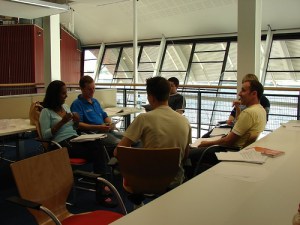 Preparing faculty to serve in this new role can ease the transition. Here are a few things to consider from the perspective of project manager, instructional designer, course developer:
Connect SMEs with training on the LMS (and maybe even basic HTML editing) – Know the workshop schedules, the good online tutorials, and have a contact on the faculty development and support side you can personally put the SME in contact with. While the SME will not usually be responsible for loading content into a LMS, it may help for them to understand where you’re going.
Connect with training on online instruction – If the SME doesn’t have a lot of experience with online instruction, hooking him/her up with workshops and seminars related to facilitating online discussion (asynchronous/synchronous) and selecting instructional strategies can open up a few more possibilities.
Encourage networking with peers – Are there other faculty SMEs you have worked with in the past that might be willing to share feedback or lessons learned? It’s also helpful to provide examples of previously developed courses and multimedia elements.
Provide easy-to-edit formats – What you really need from the SME is input on content and revision of existing content. If a Word document works best, use it to provide them with the text that requires editing. This may create an extra step or two for the staffer responsible for getting the content online, but in the long run will save time and frustration on the part of the SME – the team member with the most challenging schedule.
Outline clear-cut responsibilities and tasks – Schedule regular meeting times (F2F or virtual) and assign tasks for all team members with specific deadlines. It’s a team effort and all of the pieces need to come together as smoothly as possible. Outline roles and expectations and review the project’s production schedule periodically with the group.
Develop a written Memorandum of Agreement – Perhaps this should be listed first. As the SME is identified and prepares to join the team outline in writing the project’s purpose (new course, revision), development timeline, roles and responsibilities of all team members. Also address compensation and how copyright and acknowledgements will be handled. Best to go ahead and get these conversations started.
Foster a supportive climate – Encourage creativity, innovation, input and feedback throughout the process. This goes for the team as a whole, not just the SME. Everyone has a role to play and ideas to contribute. What has this faculty member always wanted to try or include in the course, but didn’t have the resources to do alone? Now may be the time.
Communicate clearly and often – Early on it is helpful to develop some kind of communication plan. How does the SME prefer to be contacted with updates, requests for review, changes – email, phone? Find what works and document progress on at least a monthly basis.
Do you work with faculty content experts to develop online courses? Please add your comments and suggestions to the list.
photo credit: jisc_infonet, Flickr


 of learning, that is?”
 This blog is one year old as of this month! I’ve enjoyed the process of writing it (including figuring out what to write about) and learning more about blogging in general along the way. Personally, this endeavor has become a sort of creative outlet and a source of self-directed professional development. Now that my ‘voice’ is starting to take shape I feel the need to set a few basic goals to grow and improve the project from this point forward.
 Design Doc