
From a project management perspective getting a brand new course moving can be a challenge. With a course revision, you’ve got a full draft right from the beginning in the form of the exiting course. With a new course, the momentum has to come from a complete stop. The work of Subject Matter Experts (SMEs) is critical in the design stage to ensure that the scope and sequence of the specific content and source(s) of content are all appropriate. SMEs who are also filling other professional roles, such as full-time faculty, need support that helps them to provide their expertise, stay focused on project goals, and complete assigned tasks on schedule.
The project manager/instructional designer can provide tools that both manage the process and result in the information developers need to build the course. For a new course, starting with a high-level outline can be helpful. A simple table can serve this purpose: organizing thoughts and documenting a plan for the course. The format allows for moving things around and review by others on the team.
In the illustration below, columns list the components of a course unit and each row represents one unit (one week per unit is a typical – but not required or even recommended – way to plan).
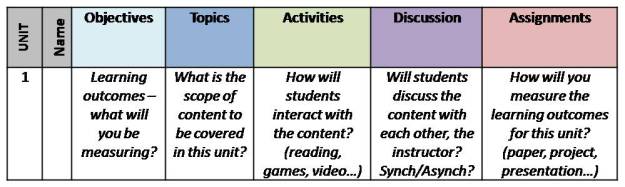
Possible advantages of this approach:
- Provides easy access for others on the team – to contribute, review, edit (Consider posting as a GoogleDoc or in a system that allows for file sharing and version control like Sharepoint or Basecamp).
- Structures the course before moving to the more cumbersome and detailed development guide for full writing of the course.
- Becomes a primary reference document for the course – you can go back to it.
- Allows for division of labor later on – multiple people working on separate units at the same time.
- Offers flexibility – add columns as needed (e.g. case study) and your own course/program nomenclature.
- Provides documentation for approval at a critical point in the process – before development goes forward.
This is a plan, not a prescription. Not all units will require a synchronous seminar or have assignments due. In the next phase of development (writing the course content in a development guide) the outline may change somewhat, but it is there in the beginning to show the way forward.
It’s a simple tool that takes some time to complete early in the process. This time on the front-end will likely save your schedule later on. Take the time to frame the house before you begin to buy the furniture, or even put up drywall.
Do you use something like this to get a new course project moving? How do you provide initial support and guidance to content experts and course writers? Please share!
 I was recently asked to make textbook recommendations for an Instructional Design course. One member of the team recommended I review
  This blog recently went through a name change, from “Talking and Typing About…” to “DesignDoc”. One interpretation of “DesignDoc” is a formal outline of what will be developed for a course, as in an Instructional Design Document. This document can be used to map out what will be developed and is often used as an agreement of work to be done before development starts. My experience has been that every workplace has its own version, requirements, and format, but the elements are pretty consistent.
 Design Doc