

Author Archives: Melissa A. Venable

Unknown's avatar

About Melissa A. Venable

Working at the intersection of instructional design and technology, social media, and career development.

Instructional Designer Profile – Oma Singh

The field of Instructional Design (ID) is still relatively new and professionals enter this work in a variety of ways. The possible projects, work settings, methods, job titles and descriptions are many. The goal of this planned series of posts is to introduce you to practicing instructional designers so that you can learn more about their perspectives and work.

Meet Oma Singh!

Oma is currently the Assistant Director for Assessment for a faculty support center at a large public university. Oma received her Ph.D. in Instructional Technology with a cognate in Adult Education from the University of South Florida. She has extensive experience and education in the field of Management Information Systems, and has held positions as a computer programmer, instructional designer, and instructor to name a few. Oma believes in putting theory into practice and is committed to lifelong learning and helping others learn through innovative use of technology.

Q:  How did you enter the field of instructional design/technology?

A:  I wanted to move from a business perspective of technology use to an educational perspective of technology use. I have found that an educational perspective is personally more rewarding for me.

Q:  What is the most rewarding part of your work?

A:  Actually seeing the course you developed up and running smoothly online. It felt good.

Q:  What is the most challenging part of your work?

A:  Getting the Subject Matter Experts (SME) to provide accurate content on time. Guiding the SMEs to avoid plagiarism and to keep their content authentic, to the point, and original, while avoiding fluff and fillers. This is especially true for online learning.

Q:  What do you wish you knew more about?

A:  I would like to learn more about different content development tools.

Q:  Are you currently involved in professional development activities?

A:  I attend and present at various conferences and teach myself tools that IDs are using currently. I subscribe to instructional design related blogs and journals.

Q:  What advice do you have for someone entering the instructional design field?

A:  Develop a set of skills that are considered valuable in the instructional design field – going beyond PowerPoint! Subscribe to ID blogs. Download free trials and create your own online course or a mini-course. Create an ePortfolio, putting your examples online, and make it professional for job hunting. Volunteer to develop courses or online interactions for school, home, church, community – anything that will get you some experience. If you are in school, get a part-time ID job!

Q:  If you had to name/predict the most important trends for the future, what would they be?

A:  More learning interventions that are similar to apps developed for the iPad. More 3D type simulations. Interactive eBooks.

Oma’s responses provide us with a quick look at the work of an instructional designer in higher education administration supporting faculty with the development of online educational experiences. Did any of her responses surprise you? What else would you like to know?

Photo credit: Stock.Xchng
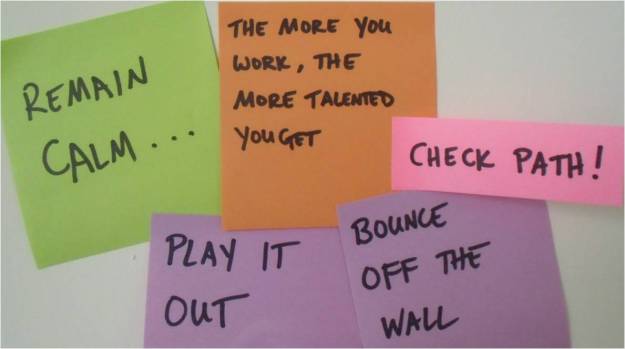
Remain Calm…Part II

Earlier this year, in a post titled Remain Calm…and other writing on my wall, I wrote about collections of sayings, mantras, and quotes, we have at our desks. It’s time to share a few more.

The more you work, the more talented you get. – This one is everywhere, particularly with the small business, entrepreneur crowd I’ve been following lately. Ever notice how the hardest working people are the “luckiest”, too? Skill, talent, luck – it’s the same thing with these three. The more time and effort you put into something, like instructional design, the better you and your projects will get. So…press on, keep moving forward, and read this Copyblogger post by Sonia Simone for more.

Play it out. – Sometimes you’ve done all you can do in terms of planning, design, and development. When it is time to implement, I believe in pilot testing, but there’s a point where you have to put it out there and let it see what it will do. When that time comes, be ready to evaluate and make updates as needed.

Bounce off the wall. – We’ve all hit walls at some point, right? Personal walls, professional walls, they seem to stop us in our tracks bringing our momentum to a halt. Consider the action of the bounce. How can we cushion the blow and keep moving, redirecting energy in a new direction? On a design project these walls can be new requirements, changes, delays. Instead of grinding to a halt consider other options. I can’t remember where I got this one, but maybe Tigger was onto something.

Check path! – Yes, this one has an exclamation mark. Its practical function is to remind me to check the path when tinkering with file transfers. A couple of days ago I finished reading Switch and one of the three main components of change presented is the need to  “shape the path”. In other words, we need to change our environments and develop habits that will help us get from point A to point B. Are we on the right track? If not, how do we get there? Check your project’s path, your team’s path. Help to shape them so you get where you need to go.

I know you collect these things, too. Once again I ask you to share the wealth and positive vibes.

Turning the Tables: Instructional Designer as SME

This post is a reflection on a recently completed project – I was the subject matter expert (SME) for a new online course in instructional design – a welcome opportunity to experience the course development process from a different perspective.

The project was unique in that the course being developed was an instructional design course and all of the members of the team were professional instructional designers. (Reminding me of past experiences where I had to submit a resume for positions that involved resume writing – kind of a double test! The proof is in the pudding and all of that.) I was provided with a course description and list of approved course-level learning objectives.  The next steps were up to me. This was where the adventure began. Normally I hand off a description and objectives. Time to get to work. I began by preparing and submitting a Course Outline and went from there.

Project team

My initial concern was that this could become a case of too much input or competitive in nature, but this was not the case. Collaboration was a priority and effective and I learned from the team in the process.

  • Instructional Designer/Project Manager (ID/PM) – This is my usual place on the team… keep the schedule, set the deadlines, set up and facilitate progress reports and meetings, provide feedback on the work and some copy editing.
  • Multimedia Developer – Took my development guide from Word document to online course pages complete with images, icons, navigation etc. Made great suggestions related to organization and structure.
  • SME – I was to outline the scope and sequence of the content, write any text for the units, select the textbook and course materials, and create assignments.

Food for thought

What could this turning of tables do for my practice?

  • Course/Program Fit – Where does the course fit in with the program? I was provided with the development guide for the course that would precede this one in the degree plan – very helpful! Not something I usually do, but something I should do, especially with new courses and programs. Faculty SMEs tend to be more familiar with the curriculum when working on a revision.
  • Expectations –Assumptions can bog the process down. While it was clear (via detailed contract) on what to expect with this project, there were a few nuances. For example the SMEs I work with aren’t expected to create rubrics, but I was for this project. The more detail the better in the written contract and/or statement of work.
  • Volume of Content – I have heard this from SMEs, the comments about how much original content is required. And now I have experienced it for myself! When the writing of introductions, summaries, case studies etc. is required it can be more time consuming than you anticipate. Scheduling the due dates by unit, or groups of units, was helpful here.
  • Need for Feedback – The ID/PM on this project continuously gave me feedback on the content I was submitting, providing suggestions on ways to expand and clarify the presentation. I need to do more of this with my project SMEs throughout the process.
  • Finished Product – I got a sneak peak via web conference and desktop sharing at what the final version looked like. I wanted to see more! The SMEs I work with ask for this, too. After you’ve spent so much time working with the content it is a feeling of accomplishment to see the finished course online.

This project turned out to be a reality check for me about how I work with SMEs and what could be done differently. How can you improve support to your SMEs?

Image credit: schoeband, Flickr